
How to Master Sales Talent Retention in 2026 (Beyond Commission)
Effective sales talent retention in 2026
It requires moving beyond basic commission structures to cultivate environments rich in psychological safety, modern tooling, and professional development. If you are still relying solely on high commission checks to keep your heavy hitters, you are already losing them. In the high-stakes world of modern B2B sales, the data is undeniably clear: top performers are prioritizing purpose and workflow efficiency over simple financial transactions.
According to 2026 market data from Thirst.io, nearly 51% of employees are actively seeking new roles, and the number one reason for quitting is a toxic or stagnant work environment (32.4%). At Legacy Sales Engagement, we have observed firsthand that the most successful organizations aren't just "hiring" salespeople; they are architecting ecosystems where loyalty is a natural byproduct of excellent leadership. This guide will walk you through why a DIY approach to team building is a massive risk to your pipeline and how to implement a world-class retention strategy today.
📌 Key Takeaways
Upgrade your tooling: Reps will leave if forced to use outdated CRMs; invest in AI-driven sales engagement platforms.
Provide dual leadership tracks: Offer clear career progression for both future managers and elite individual contributors.
Ditch the DIY culture: Partner with professionals to diagnose the actual root causes of sales turnover.
Foster psychological safety: Create a space where lost deals are treated as learning opportunities, not punishable offenses.
Table of Contents
The 2026 Shift: Why Money Isn't Enough
The Dangerous Pitfalls of DIY Sales Management
Mastering Sales Talent Retention: 5 Pillars of Success
Why Professional Sales Engagement is the Solution
Frequently Asked Questions (FAQ)
Conclusion: Your Legacy Starts With Your People
The 2026 Shift and Why Money Isn't Enough
Quick Answer: The paradigm of sales talent retention has shifted because modern top performers value autonomy, professional mastery, and psychological safety just as highly as financial compensation. A purely "coin-operated" approach is now obsolete.
In previous decades, a "coin-operated" sales force was the undisputed norm. You provided a territory, a basic CRM, and a lucrative compensation plan, and the talent stayed. However, recent global workplace reports from Gallup show that baseline employee engagement is at a critical low.
What Elite Sales Professionals Actually Want
Today's elite sales professionals—those who consistently hit 120% of quota or higher—are looking for more. They want to know their daily grind has a legacy impact. They seek corporate environments that offer:
Autonomy: The freedom to manage their book of business like an independent franchise.
Professional Mastery: Continuous, advanced learning that goes far beyond basic product feature knowledge.
Purpose: Alignment with a company mission that genuinely solves tangible human or business problems.
If your strategy for sales talent retention starts and ends with the finance department, your top 10% are likely already responding to LinkedIn messages from recruiters.
📊 Data Point: In 2026, 83% of workers state that work-life balance and psychological safety are more important than pay alone. Neglecting these areas guarantees a high turnover rate.

The Dangerous Pitfalls of DIY Sales Management
Quick Answer: Do-It-Yourself (DIY) retention strategies fail because internal leaders often lack objective data, rely on outdated coaching methods, and cannot properly diagnose the root causes of rep burnout.
Many well-meaning CEOs and founders attempt a DIY approach to retention. They read a few trendy management books, host an annual pizza party, and cross their fingers. Unfortunately, this inevitably leads to "The Great Leak", where your absolute best people quietly hand in their notices.
The True Cost of Turnover
We strongly discourage a DIY approach to sales culture because professional intervention is required to diagnose systemic friction points. According to industry insights from SHRM, replacing a high-performing salesperson costs an average of 1.5x to 2x their annual salary. This calculation factors in recruitment fees, onboarding time, and massive lost opportunity costs.
⚠️ Common Mistake: Assuming your top biller is naturally happy. High performers often mask burnout perfectly until the day they resign. Never equate high quota attainment with high job satisfaction.
Mastering Sales Talent Retention: 5 Pillars of Success
Quick Answer: To retain top salespeople, organizations must implement advanced training, offer radical work flexibility, provide modern tech stacks, define clear career paths, and foster deep psychological safety.
To truly secure your team's loyalty, you must move beyond the transactional "hiring" mindset and adopt a "cultivation" mindset. Here are the five foundational pillars we implement to ensure long-term stability.
1. Advanced Professional Development
Top performers are terrified of career stagnation. In 2026, sales talent retention is directly linked to the quality of training provided. Organizations with aggressive learning cultures see 2x higher retention rates. This ongoing training must include neuroscience-based sales tactics, AI-augmented outreach strategies, and emotional intelligence (EQ) workshops.
2. Radical Flexibility and Hybrid Options
The shift toward hybrid work is permanent. Over 74% of UK and US workers prefer hybrid models. Forcing top-tier hunters into a rigid cubicle environment for 40 hours a week is a surefire way to lose them. Trust your A-players to manage their outcomes, not their hours.
3. Modern Sales Engagement Platforms
Give your team the modern tools required to win. If they are fighting against a clunky, 10-year-old CRM, they will leave for a competitor that uses modern sales engagement platforms. Tools like automated sequence outreach and AI-driven predictive recommendations are no longer optional perks; they are essential retention tools.
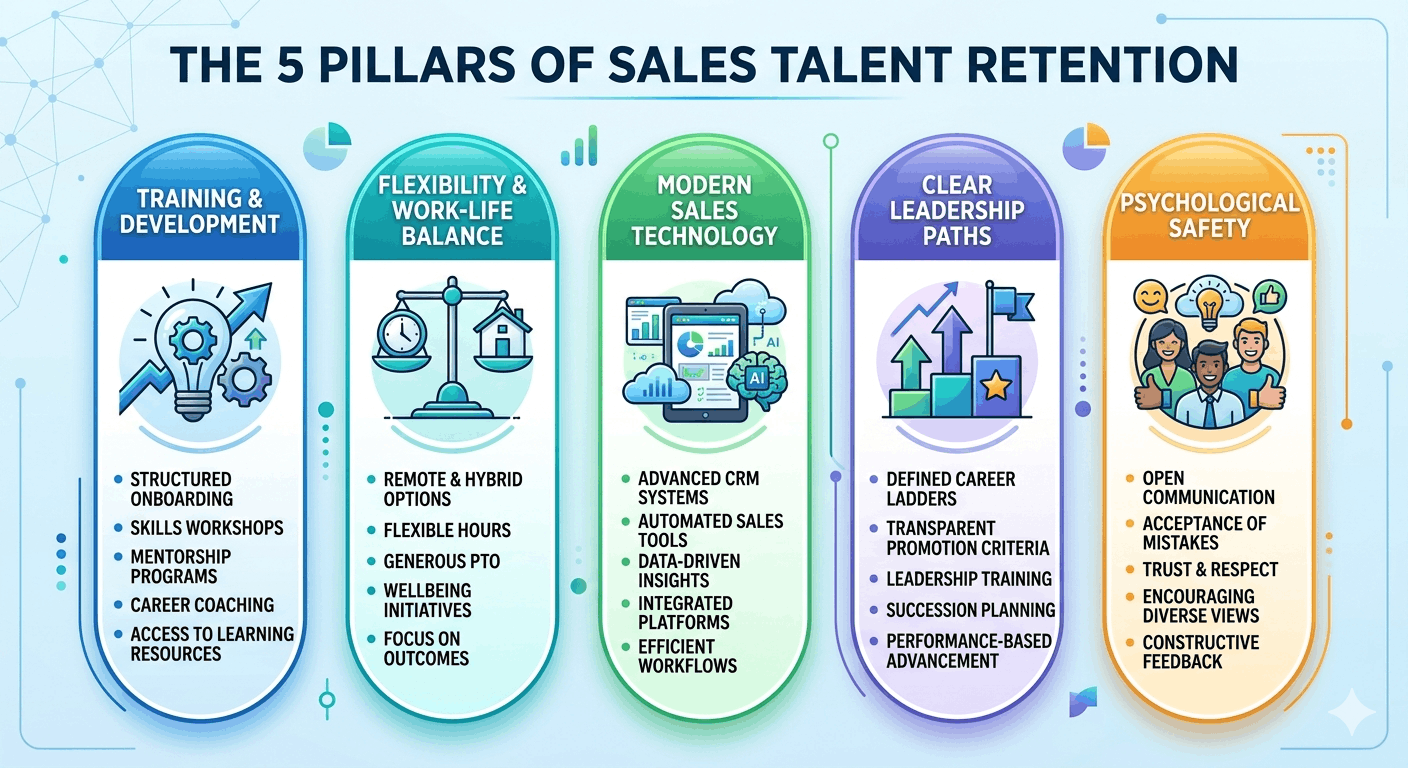
4. Direct Paths to Leadership (The Dual-Track Model)
A massive error in sales talent retention is assuming every great closer wants to be a middle manager. Provide two distinct career paths: a management track for those who want to lead people, and an "Elite Individual Contributor" track for those who want to remain in the field but gain seniority, better territories, and higher base pay.
5. Psychological Safety and Belonging
Over 55% of workers say they would quit if they didn't feel a deep sense of belonging. Creating an environment where reps can share "losses" and blown deals without fear of retribution allows for much faster team-wide learning and deeper corporate loyalty.
Why Professional Sales Engagement is the Solution
Quick Answer: Professional sales consultants bring objective data, customized coaching frameworks, and process optimization that internal leaders are often too close to the problem to see.
You wouldn't ask your accountant to perform heart surgery; why would you ask an untrained manager to fix a broken, toxic sales culture? Professional consultants provide the explicit expertise and real-world experience needed to transform a revolving door into a stable, high-performance revenue engine.
How External Expertise Drives Retention
At Legacy Sales Engagement, we specialize in identifying the hidden friction points in your sales process that actively frustrate your best people.
Customized Leadership Coaching: We turn stressed managers into empathetic mentors who actively drive sales talent retention.
Sales Process Optimization: We aggressively remove the administrative "busy work" that kills morale.
Culture Audits: We use data to find out why your people are actually leaving.
💡 Expert Insight: "True sales leadership isn't about pushing people harder to hit numbers; it's about removing the operational obstacles that prevent them from doing so natively." — Senior Consultant, Legacy Sales Engagement.
✅ Quick Tip: Conduct "stay interviews", not just exit interviews. Ask your current top performers what keeps them at the company and what might tempt them to leave before they start looking.
Frequently Asked Questions
What is the biggest driver of sales talent retention in 2026?
While competitive compensation remains a baseline requirement, the biggest drivers in 2026 are psychological safety, flexible work arrangements, and access to modern, AI-driven sales technology that eliminates administrative busywork.
How does a bad CRM affect sales turnover rates?
A clunky or outdated CRM forces sales professionals to spend hours on manual data entry rather than revenue-generating activities. This directly leads to burnout, frustration, and eventual resignation as reps seek employers with frictionless tech stacks.
What is the "Dual-Track" career model in sales?
The dual-track model provides two distinct avenues for promotion. One track is for reps who want to become sales managers, while the other allows top performers to remain individual contributors with increased seniority, better titles, and higher pay without taking on management duties.
How much does it cost to lose a top sales performer?
According to HR industry benchmarks, replacing a high-performing salesperson costs between 1.5x to 2x their annual salary. This accounts for recruitment fees, training costs, and the significant revenue lost while the territory is empty or ramping up.
Why do DIY retention strategies fail for sales teams?
DIY strategies typically fail because internal leadership is too close to the problem to see structural flaws. They often treat the symptoms (like low morale) with superficial fixes rather than addressing the root causes, such as poor coaching or broken sales processes.
Your Legacy Starts With Your People
In the highly competitive landscape of 2026, sales talent retention is your ultimate competitive advantage. While your competitors remain stuck in an expensive "hire and fire" cycle, you can build a sustainable legacy of excellence by deeply investing in your people's growth, mental well-being, and professional tooling. Do not settle for a DIY approach that leaves your pipeline and revenue at constant risk.
Next Steps to Secure Your Sales Team:
Audit your current tech stack to ensure it is reducing friction, not creating it.
Implement formal "stay interviews" with your top 20% of performers this quarter.
Establish a clear dual-track career path for both management and elite contributors.
Partner with professional sales consultants to conduct a comprehensive culture audit.
Stop losing your best talent to the competition.Contact Legacy Sales Engagement today to build a retention strategy that honors the human element of modern sales.