
Maximizing Trade Show ROI to The Ultimate Lead Conversion Guide
Maximizing trade show ROI requires a systematic transition from passive booth-sitting to active, multi-channel sales engineering.
The exact answer to turning event leads into revenue is implementing a strict 48-hour follow-up sequence, utilizing CRM automation, and scoring leads before they ever leave your booth. Every year, B2B companies pour billions into convention centers, custom-built booths, and premium swag. Yet, a staggering number of these organizations fail at the most critical step: converting those handshakes into closed-won deals.
The true "ROI" of an exhibition isn't measured by the number of pens you gave away. It is measured by the velocity at which a physical interaction transforms into a digital pipeline entry. When you return to the office with a stack of business cards, you aren't holding permanent contact info; you are holding rapidly expiring assets.
📌 Key Takeaways
Pre-book meetings: Secure 50% of your calendar before the trade show begins to ensure high-intent conversations.
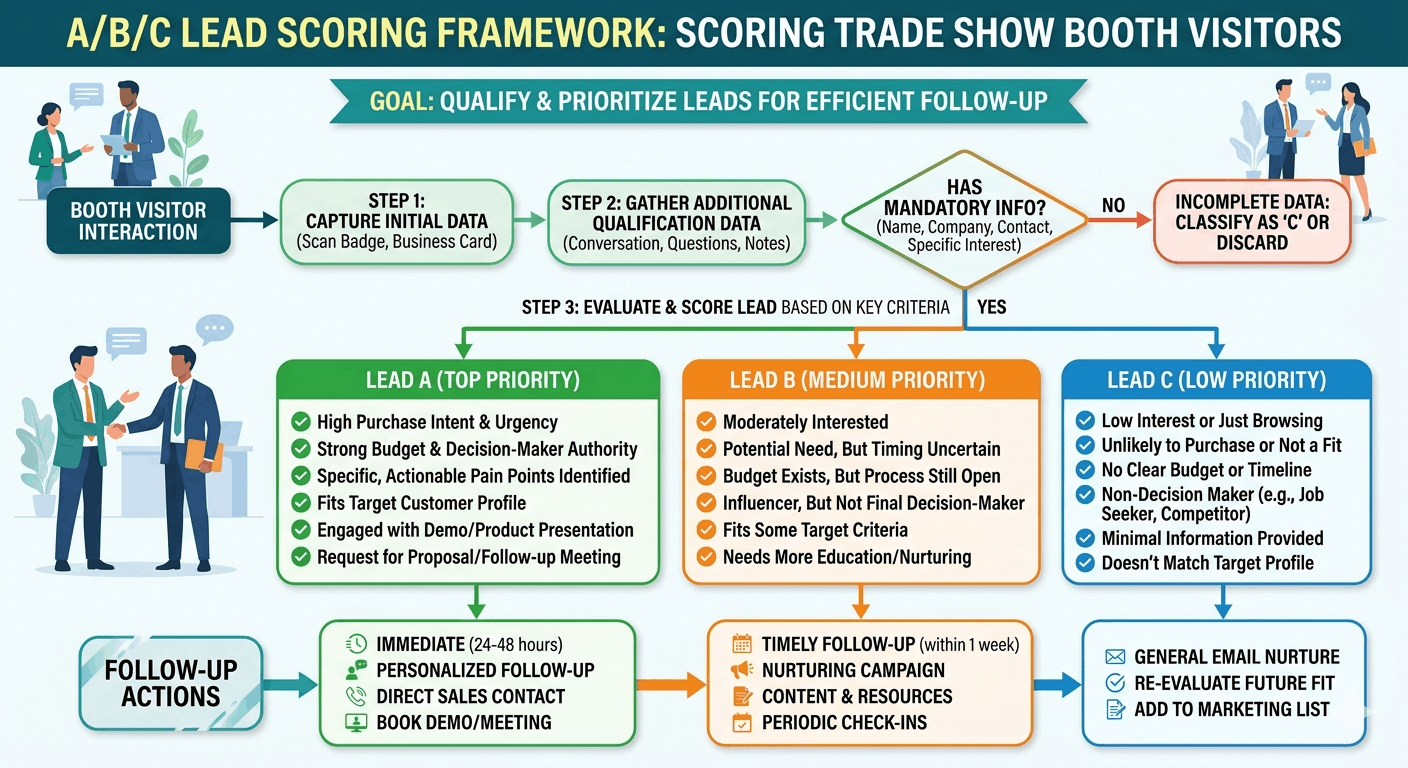
Score leads instantly: Categorize every booth visitor using a strict A/B/C framework to prioritize follow-ups.
Ditch the DIY follow-up: Replace manual, delayed emails with an automated, multi-channel 48-hour sequence.
Integrate CRM data: Funnel trade show contacts directly into Salesforce or HubSpot for closed-loop reporting and long-term nurturing.
Table of Contents
The Hard Truth About Trade Show Lead Management
Why "DIY" Lead Management is a Revenue Killer
Phase 1: Strategic Pre-Show Engineering
Phase 2: On-Site Conversion Tactics
Phase 3: The 48-Hour Gold Rush Follow-Up Strategy
The Case for Professional Sales Engineering
Advanced CRM Integration for Scalability
Frequently Asked Questions (FAQ)
Conclusion: Building a Legacy of Sales Growth
The Hard Truth About Trade Show Lead Management
Quick Answer: The value of a trade show lead drops exponentially within days of the event. Maximizing trade show ROI means recognizing that business cards are depreciating assets that require immediate, structured digital follow-up.
The traditional approach to event lead generation is fundamentally broken. Relying on smiles exchanged at the cocktail hour rarely translates to bottom-line growth. Every hour a lead sits on a desk, its conversion potential plummets.
To win in the modern B2B event marketing landscape, you must treat your trade show presence as a high-fidelity data acquisition event. This requires abandoning outdated tactics and adopting professional sales engineering frameworks.
📊 Data Point: According to the Center for Exhibition Industry Research (CEIR), nearly 80% of trade show leads are never followed up on by sales teams. This represents millions in lost potential revenue.
Why "DIY" Lead Management is a Revenue Killer
Quick Answer: "Do-It-Yourself" lead management fails because it lacks persistence, relies on inconsistent messaging, and falls victim to the "post-show slump," resulting in lost deals and wasted marketing budgets.
The "Do-It-Yourself" (DIY) approach to trade show follow-up is the primary culprit behind low conversion rates. Typically, a sales rep manually types names into an Excel sheet three days late. They send a generic "Great to meet you" email and abandon the effort when they don't get a reply.
The Breakdown of DIY Methods
The DIY approach fails for three distinct reasons:
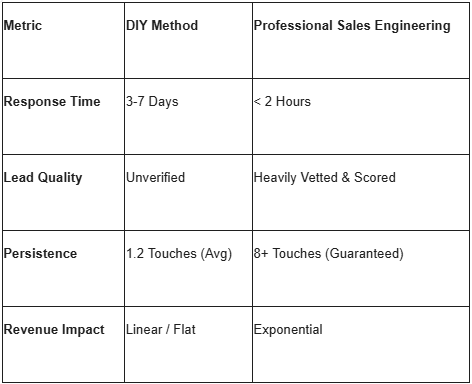
Lack of Persistence: Research shows it takes 6–8 touches to convert a cold prospect. DIYers usually stop at one or two.
Inconsistent Messaging: Without a professional framework, every rep improvises, diluting your brand's core authority.
The "Post-Show Slump": Exhausted teams revert to their existing pipeline, leaving new leads to freeze.
⚠️ Common Mistake: Waiting until you are back in the office to organize your leads. If you are uploading business cards to your CRM on the following Tuesday, your competitors have already booked the demo.

Phase 1: Strategic Pre-Show Engineering
Quick Answer: Successful trade show lead generation begins 60 days prior to the event. This phase involves pre-booking VIP meetings and aligning your digital content to the specific theme of the conference.
Maximizing trade show ROI begins long before the doors open. If your calendar isn't at least 50% booked before you arrive at the airport, you are already playing catch-up.
The Power of Pre-Booking
Professional sales organizations execute targeted outbound campaigns to secure VIP meetings weeks in advance. While competitors wait passively for foot traffic, you should be hosting high-level strategy sessions in your private meeting area.
Digital Alignment
Ensure your landing pages are strictly optimized for the specific show. For example, if you are attending a SaaS summit, your services page must highlight relevant technical capabilities. Internal linking between your show-specific content and core services helps search engines index your topical authority.
Phase 2: On-Site Conversion Tactics
Quick Answer: Treat your booth as a lead qualification laboratory. Use strict lead scoring mechanisms and capture contextual metadata to separate high-intent buyers from casual information seekers.
Your booth is not a lounge; it is a rapid-fire qualification center. You must aggressively distinguish between "Information Seekers" and "Problem Solvers".
Implement Mandatory Lead Scoring
Every individual who visits must be ranked using a standardized framework, such as the BANT (Budget, Authority, Need, Timeline) methodology. Categorize them instantly as A, B, or C leads.
💡 Expert Insight: "A name and an email address are useless without context. You need to know the 'Why.' Why did they stop at your booth? What specific pain point are they trying to solve today?"
Provide Instant Gratification
Leverage technology to deliver value immediately. Send a digital whitepaper or a highly relevant case study directly to their inbox while they are still standing in front of you. This establishes immediate trustworthiness and creates a digital footprint.
Phase 3: The 48-Hour Gold Rush Follow-Up Strategy
Quick Answer: The highest converting trade show ROI is generated within the first 48 hours. Execute a multi-channel sequence that includes emails, LinkedIn connections, phone calls, and personalized video assets.
The true "Pipeline of Gold" is forged in the first 48 hours post-interaction. This is the critical stage where DIY efforts crumble, and structured post-show nurture sequences shine.
The Multi-Channel Sequence
A simple email is not a strategy. A professional event lead generation sequence looks like this:
Hour 4: Automated, personalized "Thank you" email containing a link to a specific resource discussed at the booth.
Hour 24: Personalized LinkedIn connection request from the specific representative they interacted with.
Hour 48: A direct phone call to schedule a formal "Deep Dive" discovery session.
Day 4: A short Video Sales Letter (VSL) recapping your unique value proposition.
By utilizing this comprehensive, multi-channel approach, you remain top-of-mind while your competitors remain buried in a suitcase.
✅ Quick Tip: Use a tool like Loom or Vidyard to record 30-second personalized video messages for your "A-tier" leads. It dramatically increases response rates.
The Case for Professional Sales Engineering
Quick Answer: Outsourcing lead management to a professional sales engineering firm ensures a proven architecture for growth, guaranteeing faster response times, vetted lead quality, and higher revenue impact compared to internal DIY methods.
Why should you aggressively discourage DIY? Because your internal team’s most valuable resource is their time. They should be closing deals, not chasing administrative tasks.
When you partner with a professional firm like Legacy Sales Engineering, you aren't just buying labor; you are investing in a proven architecture for exponential growth. We bridge the critical gap between marketing and sales, ensuring absolute pipeline integrity.
Comparing the ROI Impact
Advanced CRM Integration for Scalability
Quick Answer: Structuring your data directly into a CRM like Salesforce or HubSpot allows for closed-loop reporting, automated nurturing of lower-tier leads, and predictive analytics for future events.
To achieve top-tier results in sales and maintain high operational efficiency, your data must be rigidly structured. Trade show contacts should flow seamlessly into your CRM environment.
The Benefits of a Structured CRM
Closed-Loop Reporting: Know exactly which booth location, team member, or show date yielded the highest revenue.
Automated Nurture Tracks: Keep "C-tier" leads warm for 6–12 months without requiring manual sales intervention.
Predictive Analytics: Utilize historical exhibition ROI data to forecast future pipeline growth accurately.
Integrating these robust systems is a complex technical endeavor that underscores exactly why amateur approaches fail modern enterprise demands.
Frequently Asked Questions
How do I accurately measure trade show ROI?
To accurately measure trade show ROI, subtract the total cost of attending the event (booth, travel, sponsorships) from the total closed-won revenue generated strictly from leads acquired at that specific show. Divide that number by the total cost and multiply by 100 to get your ROI percentage.
What is the most effective trade show lead follow-up strategy?
The most effective strategy is a 48-hour multi-channel sequence. It involves sending an automated email within 4 hours, a LinkedIn connection within 24 hours, and making a direct phone call within 48 hours to secure a discovery meeting.
How does lead scoring help in maximizing trade show ROI?
Lead scoring ensures your sales team prioritizes high-intent prospects ("A leads") immediately, rather than wasting valuable post-show energy on casual booth visitors. This targeted focus directly increases conversion rates.
Why should I use a CRM for event lead generation?
Using a CRM like Salesforce or HubSpot centralizes your data, enables automated nurturing sequences for lower-tier leads, and provides closed-loop reporting so you can trace every dollar of revenue back to the specific event.
What is professional sales engineering?
Professional sales engineering is the implementation of structured, data-driven systems to manage the lifecycle of a lead. It bridges the gap between marketing efforts and closing sales by utilizing proven frameworks rather than ad-hoc, DIY methods.
Building a Legacy of Sales Growth
Maximizing trade show ROI is entirely dependent on what happens after the convention center doors close. By abandoning the disorganized DIY mindset and implementing a professional, data-driven framework, you can transform chaotic event interactions into a highly predictable revenue engine. Stop letting valuable contacts depreciate on a desk; execute a strict 48-hour follow-up sequence, enforce immediate lead scoring, and leverage CRM automation.
Your Next Steps for Exhibition Success:
Audit your current post-show follow-up timeline and identify bottlenecks.
Establish a clear A/B/C lead scoring framework for your next event.
Integrate your badge scanning technology directly with your CRM.
Draft your multi-channel 48-hour follow-up sequence today.
Ready to turn your next event into a scalable pipeline of gold? Contact Legacy Sales Engineering today, and let’s build an automated follow-up system that never misses a beat.