
The Ultimate 2026 B2B Sales Playbook: Proven Strategies to Scale
The 2026 B2B Revenue Playbook: Adapting to the Multi-Threaded Buying Committee
Quick Answer: Modern B2B sales is the systematic process of selling complex solutions to business entities through a multi-threaded buying committee. In 2026, success requires replacing aggressive outbound pitching with consultative, data-driven frameworks that help matrixed corporate teams build internal consensus and justify ROI.
If you sell to other businesses, your old playbook is quietly costing you deals. The landscape of business commerce has fundamentally shifted. It has moved from a representative-led pitch to an independent, buyer-driven journey.
Today's corporate buyers research deeply before you ever meet them. They form rigid vendor preferences early. They also bring more stakeholders to the evaluation table than ever before.
This masterclass is built specifically for revenue leaders and B2B founders. It provides a practical view of modern commercial operations. You will learn what converts today and how to fix structural pipeline leaks.
📌 Key Takeaways
Adapt to the Matrix: Average buying groups now involve 10 to 22 cross-functional stakeholders.
Qualify Rigorously: Switch from traditional BANT to MEDDPICC for complex enterprise deals.
Quantify the Pain: Always tie your solution to a mathematically defensible business case.
Multi-Thread Early: Build deep operational relationships across IT, Finance, and end-users.
Govern Your Tech Stack: Use AI conversation intelligence to pinpoint coaching opportunities.
Table of Contents
What Modern B2B Sales Actually Means
How B2B and B2C Sales Differ
The 7-Stage Sales Process Blueprint
Qualification Frameworks That Predict Wins
Navigating the Buying Committee
Advanced Strategies for Predictable Revenue
Solving Common Operational Challenges
The Modern Revenue Tech Stack
Frequently Asked Questions
At its core, B2B sales describes the systematic process of selling commercial solutions from one enterprise to another. It involves large financial contracts and strict risk mitigation.
Typical examples include SaaS providers selling CRM platforms. It also includes consulting firms optimizing global supply chains. The financial size of the deals is significant. However, the true complexity lies in the purchasing decision itself.
Characteristics of Modern Enterprise Purchasing
Modern business purchases share four distinct characteristics. First, they are heavily researched autonomously. Buyers complete up to 70% of their journey independently.
📊 Data Point: According to MIT Sloan research on digital commerce, buyers leverage AI-powered search engines and peer communities long before contacting a vendor.
Second, decisions are made by a matrixed group. Single-threaded selling is completely obsolete. Third, purchases are strictly justified with quantifiable numbers. Emotional impulses do not drive enterprise contracts.
Finally, contracts are engineered for multi-year retention. A signed agreement marks the beginning of the client lifecycle. Long-term customer retention drives enterprise valuation.
Quick Answer: While B2C sales rely on emotional resonance and quick transactions, B2B cycles are long, strategic, and require consensus from multiple corporate stakeholders evaluating financial ROI.
Attempting to run a consumer playbook in an enterprise environment will burn your pipeline. You will frustrate prospective buyers and stall opportunities. You must understand the profound structural variations.
Every go-to-market strategy must align with these high-stakes parameters. Your outbound motion and negotiation frameworks depend on this understanding.
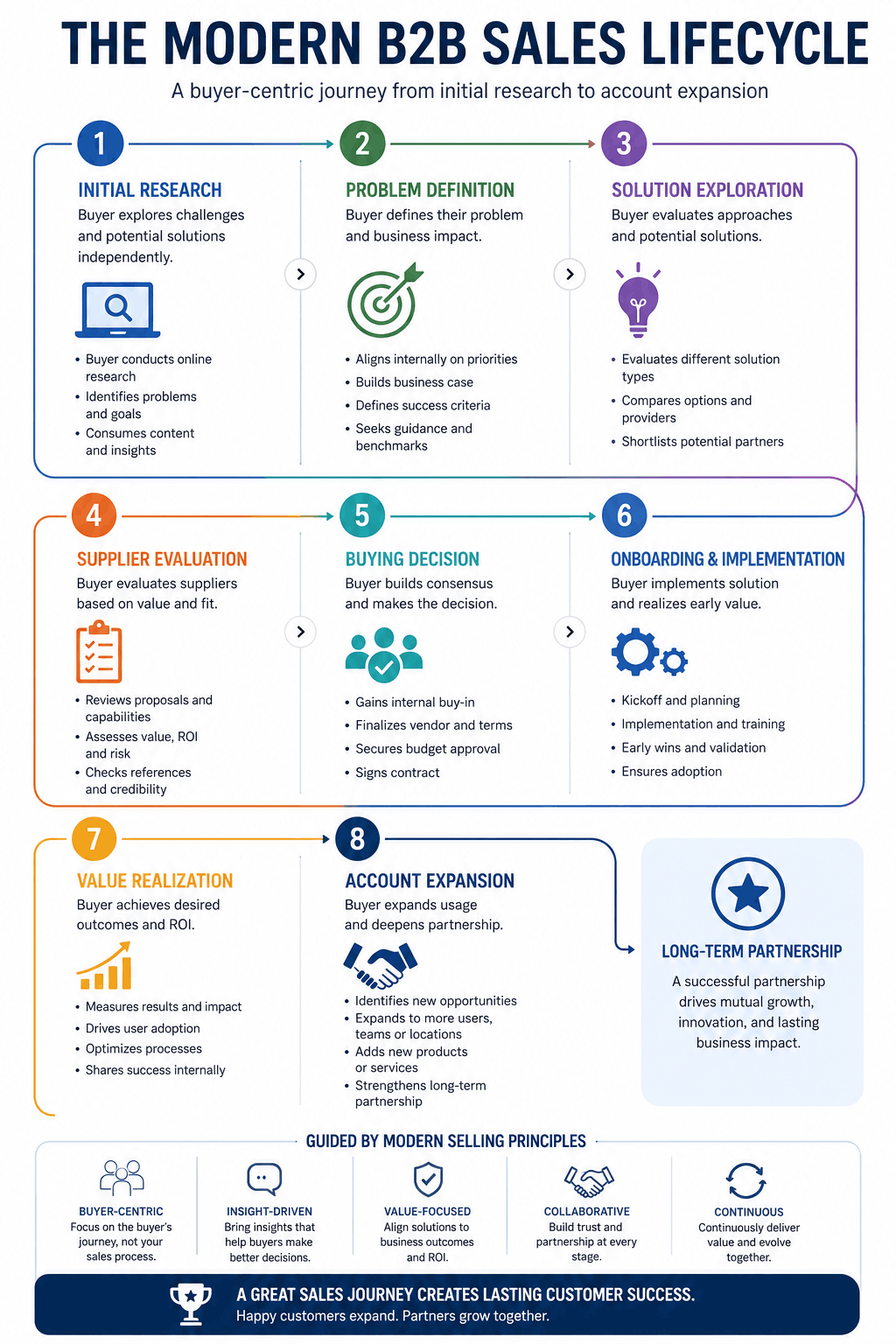
A highly structured process transforms individual talent into a predictable revenue organization. Forecasting accuracy and pipeline velocity depend on unified team execution.
Stages 1-3: Prospecting and Discovery
Stage 1: Account Prospecting. Engage target accounts that strictly align with your Ideal Customer Profile. Blend outbound execution with inbound demand generation architecture.
Stage 2: Deep Discovery. This is the most critical interaction. Accurately diagnose the prospect's operational situation. Decide whether the opportunity warrants your limited resources.
⚠️ Common Mistake: Treating a discovery call like a generic product pitch. Reps must lead with diagnostic questions, not feature dumps.
Stage 3: Operational Needs Analysis. Deeply quantify the financial cost of the underlying problem. If an inefficiency costs $50,000 monthly, your $10,000 solution becomes an obvious choice.
Stages 4-7: Presentation and Closure
Stage 4: Tailored Presentation. Demonstrate only the specific capabilities that address uncovered pain points. Generic feature dumps lose enterprise deals rapidly.
Stage 5: Proposal Construction. Deliver a formal proposal detailing scope, pricing, and ROI. Equip your internal champion with highly scannable collateral.
Stage 6: Commercial Negotiation. Avoid reflexive discounting. Refocus the dialogue on mutual value creation. Utilize Mutual Action Plans to guide procurement.
Stage 7: Client Onboarding. The post-sale handoff dictates customer lifetime value. A frictionless onboarding experience reduces buyer's remorse immediately.
Rigorous qualification separates a healthy revenue pipeline from a museum of stalled deals. Your methodology depends on your average contract value.
💡 Expert Insight: At Legacy Sales Engineering, we find that teams transitioning from BANT to MEDDPICC instantly increase their forecast accuracy by mapping the hidden legal and procurement hurdles early.
For deals above $25,000, MEDDPICC vastly outperforms traditional BANT. It systematically evaluates Metrics, Economic Buyer, Decision Criteria, and Paper Process. It explicitly forces representatives to uncover hidden procurement roadblocks.
To win consistently, abandon the notion of selling to an individual. Your objective is to act as a facilitator helping a matrixed committee reach consensus.
Every account executive must map five distinct roles.
The Champion: Your internal advocate driving change.
The Economic Buyer: The executive controlling the budget.
The Technical Buyer: The IT or legal gatekeeper.
The End Users: The personnel using the platform daily.
Procurement Specialists: The professionals scrutinizing vendor risk.
If you have spoken to fewer than three of these roles, your deal will likely collapse. Multi-threaded deals are three times more likely to close successfully.
Elite revenue operations rely on specific strategic methodologies. These tactics separate top performers from inconsistent teams.
Commit to Consultative Execution
Aggressive closing tactics no longer convert sophisticated corporate buyers. Prospects want a knowledgeable, trusted guide. Ask thoughtful diagnostic questions.
Share deeply relevant case studies. Position your brand as a collaborative partner. Solve complex problems rather than pushing generic product inventory.
✅ Quick Tip: Use intent data platforms to surface accounts actively researching your software category. Reach out at the exact moment of peak interest.
Even sophisticated organizations face structural headwinds. Scaling requires knowing exactly how to diagnose and address these specific bottlenecks.
Prolonged Sales Cycles
Multi-stakeholder approvals naturally slow deal velocity. To counter this, implement strict, dated Mutual Action Plans. Engage procurement departments exceptionally early in the cycle.
Deals Lost to "No Decision"
Your biggest competitor is the status quo. Help your champion build a defensible business case focused on the "Cost of Inaction". Deals stall when value cannot survive financial scrutiny.
To calculate your team's efficiency, use this pipeline velocity formula:
Velocity = Opportunities x Deal Size x Win Rate x Cycle Length
Inbound Lead Quality Issues
Reps waste hours chasing low-intent prospects lacking budget. Immediately tighten your firmographic definitions. Run automated enrichment audits and disqualify unfit accounts aggressively.
Software alone will never fix a broken process. However, a modern tech stack acts as a force multiplier for an effective one.
High-performing teams prioritize core layers. They use CRM platforms as the single source of truth. They deploy sales engagement automation for multi-channel sequencing.
They leverage revenue intelligence engines like Gong or Chorus. These platforms use AI to expose hidden objection patterns. Finally, they use data enrichment platforms to secure verified contact information.

What is the definition of B2B sales?
B2B sales involves businesses selling complex products, software, or services directly to other commercial enterprises. It is characterized by long sales cycles, large contract values, and purchasing decisions made by a multi-threaded committee rather than a single consumer.
What are the most important B2B sales skills today?
The most vital skills include structured problem diagnosis, deep active listening, financial fluency, and the operational discipline to methodically follow a strict sales process. Natural charisma matters less than the ability to build a mathematically defensible business case.
Why do enterprise sales cycles take so long?
Enterprise purchases require consensus from cross-functional groups, high-level fiscal justifications, strict security compliance audits, and lengthy legal redlining. Because multiple departments must mitigate risk, mid-market and enterprise deal cycles regularly exceed 120 to 200 days.
How do you accelerate B2B pipeline velocity?
To accelerate pipeline velocity, ruthlessly tighten your qualification criteria to filter out poor-fit accounts early. Furthermore, multi-thread every active deal to protect against champion churn, and deploy Mutual Action Plans (MAPs) to hold buyers accountable to a timeline.
What is the difference between BANT and MEDDPICC?
BANT is a basic qualification framework suited for simple, transactional deals focusing on Budget, Authority, Need, and Timeline. MEDDPICC is an advanced framework for complex enterprise deals that maps hidden legal hurdles, economic buyers, and specific decision criteria.
Final Thoughts: Engineering a Revenue System
Sustainable revenue growth is never the result of a few star performers. It is engineered by building a scalable system around a deeply mapped buyer journey. You must enforce rigorous qualification frameworks and foster a culture of continuous coaching.
To scale your operations this quarter, take these immediate steps:
Audit your current pipeline stages to ensure they reflect actual buyer actions, not just rep activities.
Enforce multi-threading rules, requiring reps to engage at least three stakeholders per account.
Replace outdated BANT criteria with the MEDDPICC framework for all enterprise-tier deals.
Integrate conversational AI intelligence to locate exact behavioral coaching gaps.
The market leaders treat revenue operations as an engineering challenge. If your current motion feels like guesswork, it is time to build a reliable architecture. Partner with our team to design predictable growth by exploring our Legacy Sales Engineering frameworks.