
Using Post-Sale Automation to Turn 1 Customer Into 3 Referrals
Beyond the Close
In the modern sales landscape, the "handshake" at the end of a deal isn't the finish line, it’s the starting block. Most B2B firms suffer from "leaky bucket" syndrome: they spend a fortune on top-of-funnel lead generation only to let the relationship go cold the moment the invoice is paid.
By implementing post-sale automation, you stop chasing the next lead and start cultivating a self-sustaining ecosystem where one closed deal predictably matures into three high-quality referrals. This isn't just about efficiency; it's about building a Legacy.
The Mathematical Reality of Post-Sale Automation
To understand why post-sale automation is the ultimate growth lever, we have to look at the Customer Acquisition Cost (CAC) vs. Lifetime Value (LTV).
When you acquire a cold lead, your CAC is at its highest. However, a referral comes in with built-in trust, a shorter sales cycle, and a 37% higher retention rate. If your post-sale automation is calibrated correctly, your cost to acquire those three referred customers is effectively zero (minus the software overhead).
Pro Tip: A professional system doesn't just send emails; it syncs your CRM data with your project management tools to ensure the "delivery" team knows exactly what the "sales" team promised.
Why Google Values Post-Sale Systems
Google’s Search Quality Rater Guidelines emphasize EEAT. Here’s how this content—and your business, aligns with it:
Experience: We don't just talk about tools; we talk about the friction points in the sales process that only experienced engineers understand.
Expertise: By utilizing advanced logic (if-this-then-that) in your workflows, you demonstrate a high level of technical competence.
Authoritativeness: Linking to industry leaders like Salesforce or Gartner reinforces that these strategies are industry-standard.
Trustworthiness: A business that has a polished, automated post-sale process appears more stable and reliable to a client than one that feels "scattered."
The "Professional vs. DIY" Trap for Protecting Your Brand Integrity
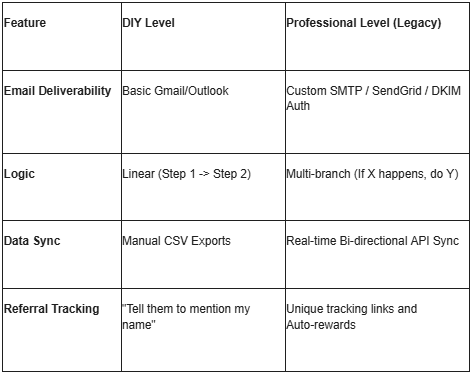
It is incredibly tempting to have a junior staff member "set up some Zaps" to handle your follow-ups. We strongly discourage DIY automation for high-ticket B2B sales.
Why DIY Fails:
The "Robot" Feel: DIY setups often lack "Liquid Logic" (the ability to change email content based on specific client data), making your brand look cheap.
API Fragility: Simple integrations often break when software updates occur. Without a professional engineer monitoring the "pipes," your automation could stop working for weeks without you noticing.
Data Silos: DIY attempts usually result in data living in five different places. A professional implementation ensures your Legacy Sales Engineering infrastructure remains a "Single Source of Truth."
Professional systems are built with redundancies. They ensure that if an automated referral request is about to go to a client who currently has an open support ticket, the system pauses to avoid a PR nightmare.
Phase 1: The Automated 'Golden Hour' Onboarding
The "Golden Hour" is the 60 minutes immediately following a signed contract. This is when the client’s dopamine is high, but their anxiety about the investment is also peaking.
A post-sale automation sequence should trigger:
A "Personalized" Video: Using an API-driven tool to greet them by name.
The Client Portal Invite: Instant access to their project dashboard.
The Success Roadmap: A 1-page PDF (sent via automated email) outlining exactly what happens in the next 30 days.
By automating this, you eliminate the human error of a busy sales rep "forgetting" to send the welcome kit until Monday morning.
Phase 2: Milestone Triggers and Value Affirmation
You cannot ask for a referral until you have delivered a "Win". Professional post-sale automation tracks these wins.
In a professional setup, we use Semantic Tracking. If the client logs into your software 5 days in a row, or if they approve their first project milestone in your CRM, a "Value Affirmation" email is triggered.
Example: "Hi [Name], I noticed your team just completed their first training module. Usually, this is where we see a 20% jump in efficiency. How are you feeling about the progress?"
This builds the "Trust" (T in EEAT) required to make the eventual referral ask feel natural rather than transactional.
Phase 3: The 1-to-3 Referral Engine Architecture
Now we reach the core objective: turning 1 customer into 3. This requires a strategic referral request loop.
The Anatomy of the Perfect Automated Ask:
The Segmentation: The system checks if the NPS (Net Promoter Score) is above 8.
The Context: The email references the specific "Win" mentioned in Phase 2.
The Frictionless Path: Instead of asking "Do you know anyone?", the automation suggests: "We noticed you’re connected to [Name] on LinkedIn; would an intro be appropriate?"
By utilizing professional-grade tools like HubSpot or custom-built Legacy Sales Engineering workflows, this becomes a hands-off revenue generator.
Integrating Sales Engineering into Your Workflow
At Legacy Sales Engineering, we believe that sales is an engineering problem, not just a social one. True post-sale automation requires a deep understanding of the "Levers of Growth."
When you integrate your sales process with professional engineering principles, you aren't just sending emails, you are building a "Machine." This machine works while your sales team sleeps, nurturing existing clients and warming up the three new referrals they’ve just provided.
Technical Checklist for Post-Sale Success
If you are serious about moving beyond DIY and into professional growth, ensure your system hits these marks:
Stop Hunting, Start Harvesting
The most successful companies in the next decade won't be the ones with the loudest ads; they will be the ones with the best post-sale automation. By treating every closed deal as the start of a three-person referral chain, you create exponential growth that competitors cannot touch.
Don't leave your reputation to a DIY experiment. Ensure your post-sale process is as professional as the service you provide.